Knowledge Base
Reading the Traceability Matrix
Two views of the same data
The Traceability page reads one underlying graph of every Requirement, ITP item, Programme activity, and BOM item in a project, and every link between them, two ways: a Heatmap for spotting sparse coverage at a glance, and a Table for triaging specific gaps. Switch between them with the view control in the header.
Coverage heatmap
Rows are requirements; columns are BOM items, ITP items, Activities, and related requirements. Cell density shows how many links connect that requirement to that column's entity kind, so a pale row or column stands out immediately as under-covered. Click a cell to see exactly which entities it's counting.
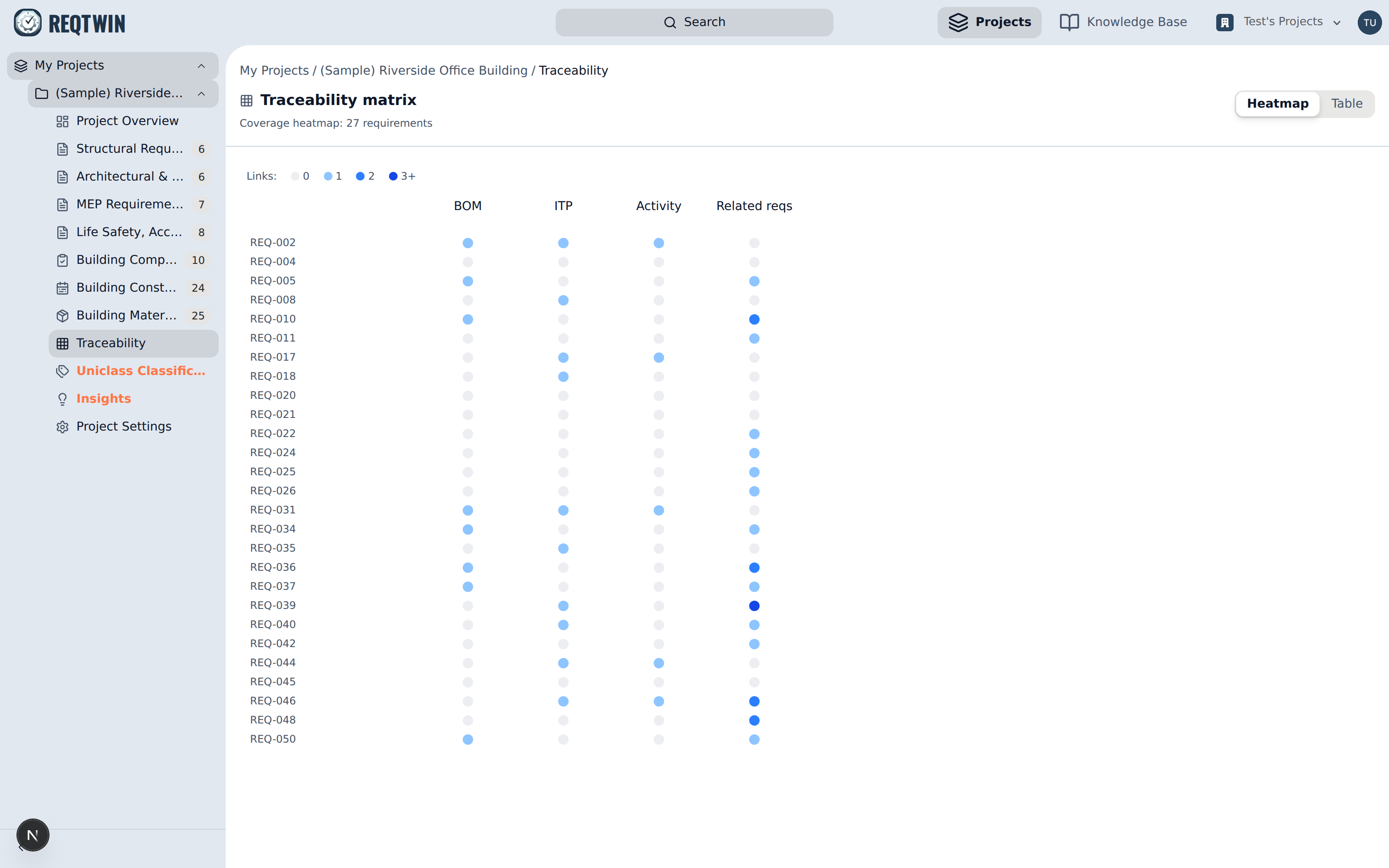
The coverage heatmap: one row per requirement, one dot per link category, shaded by link count.
The Activity column has no direct requirement-to-activity link in the data model. Its counts come from two derived chains instead: requirement to ITP item to milestone activity, and requirement to BOM item to activity (when the same BOM item links both). These show up labeled "Via ITP" or "Via shared BOM item" so it's clear they're inferred, not a stored link.
Gaps and exceptions table
The table leads with what needs attention rather than the full picture: total orphan entities (no links in or out at all), a Scope toggle between orphans and everything, and tabs to filter by entity kind. A stat tile also tracks entities changed in the last week (requirements and BOM items only, the only two with change history today).
Selecting a row opens its links, and its history if that entity kind supports it (requirements and BOM items; ITP items and programme activities don't have an audit trail yet). Link entries are honest about a real gap in the schema: nothing today records who created a link or when, so every link shows "creator: not tracked" rather than a fabricated value.
What counts as an orphan
An entity is an orphan if it has zero links in either direction, counting the derived Activity chains above. An orphan requirement, for example, is one with no ITP item verifying it, no BOM item satisfying it, and no related requirement, not just one missing a single link type.