Knowledge Base
OmniClass, UniFormat and MasterFormat for US and Canadian Projects
Four systems, two markets
In the United States and Canada, construction classification runs on OmniClass, UniFormat and MasterFormat, maintained by the Construction Specifications Institute (CSI) and Construction Specifications Canada (CSC). The UK, Australia, Ireland, Singapore and Hong Kong standardise on Uniclass instead, published by NBS.
| System | Published by | Primary use | Scope |
|---|---|---|---|
| OmniClass | CSI | Full lifecycle classification (15 tables) | USA, international |
| UniFormat | CSI / CSC | Elemental cost planning (Level A to D) | USA, Canada |
| MasterFormat | CSI / CSC | Specification work-results numbering | USA, Canada |
| Uniclass | NBS (RIBA) | Full lifecycle classification (15 tables) | UK, Australia, Singapore, Hong Kong, Ireland |
All four give every building element a unique shared identifier, but they use different table structures, code formats and hierarchies. They are also not interchangeable within a market: OmniClass, UniFormat and MasterFormat answer three different questions, and a US project typically runs all three at once rather than choosing between them.
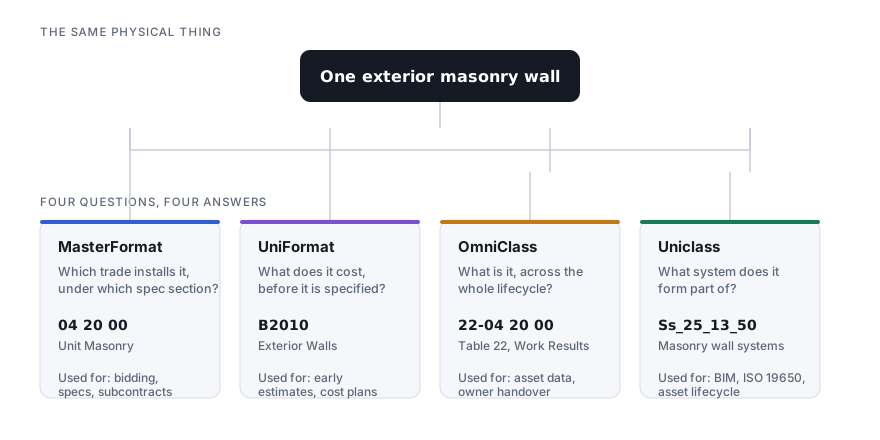
One exterior masonry wall, classified four ways. Each system answers a different question, so the four codes are not substitutes for each other.
The four codes above describe one wall. None of them is wrong, and none is a translation of the others: MasterFormat says who builds it, UniFormat says what it costs before anyone has specified it, OmniClass says what it is for the life of the asset, and Uniclass says what system it belongs to. A project that uses all four is not duplicating effort. It is answering four questions it genuinely has.
When a US owner-operator teams up with a UK BIM consultant, or a global contractor runs projects in both markets, the mismatch becomes a data problem: cost benchmarks don't translate, specification numbers don't match BIM objects, and a classification trained on one scheme can't code assets described in the other.
OmniClass, the closest US equivalent to Uniclass
OmniClass is structured around 15 tables, deliberately mirroring the ISO 12006-2 framework that also underpins Uniclass. The tables most relevant to requirements and asset management:
| Table | Name | Uniclass equivalent | Example |
|---|---|---|---|
| Table 11 | Construction Entities by Function | En (Entities) | 11-25 00 00 Hospitals |
| Table 13 | Spaces by Function | SL (Spaces/locations) | 13-35 17 10 Operating suites |
| Table 21 | Elements | EF (Elements/Functions) | 21-07 40 00 HVAC systems |
| Table 23 | Products | Pr (Products) | 23-29 23 13 Air handling units |
| Table 33 | Disciplines | PM (Project management) | 33-05 31 00 Mechanical engineering |
| Table 41 | Materials | Pr (material attributes) | 41-12 00 00 Concrete |
OmniClass uses a hierarchical numeric format (23-29 23 13) where Uniclass uses an alphanumeric one (Pr_75_65_15). Because the underlying structure is shared, cross-mapping is feasible at the level of systems and elements, though not reliably at the leaf.
UniFormat, elemental cost planning
UniFormat classifies a building by functional element rather than by product or work result. It uses a four-level hierarchy (A to D) and is the standard basis for early-stage cost planning in the US and Canada.
| UniFormat | Description | Uniclass equivalent |
|---|---|---|
| A, Substructure | Foundations, basement construction | EF_25 Substructure systems |
| B, Shell | Superstructure, exterior enclosure, roofing | EF_30 Superstructure, EF_35 Roof |
| C, Interiors | Interior construction, stairways, finishes | EF_40 to EF_55 |
| D, Services | Conveying, plumbing, HVAC, fire, electrical | Ss_60 to Ss_85 |
| E, Equipment and Furnishings | Equipment, furnishings | Pr_75 (Products) |
| F, Special Construction | Special structures, selective demolition | Co (Complexes) / Ac (Activities) |
UniFormat's strength is the pre-design and schematic estimate. A Level 2 breakdown such as B3010 Roof Coverings maps directly onto a cost rate, which is exactly what you need before any product has been specified.
MasterFormat, specification work sections
MasterFormat organises specifications by work result, what the contractor installs or does, not by functional element. It uses a six-digit section number and is the de facto standard for US and Canadian contract specifications:
Division 03, Concrete: 033000 Cast-in-Place Concrete
Division 23, HVAC: 237313 Packaged, Outdoor, Central-Station Air-Handling Units
Division 26, Electrical: 262413 Switchboards
Division 33, Utilities: 331000 Water Utilities
MasterFormat describes how something is built, not what function it serves. That makes it a companion to UniFormat (element) and OmniClass (lifecycle), not a replacement for either.
What each system is actually good at
Arguments about which standard to adopt usually come from treating them as competitors. They are better read as tools with different jobs, and the question worth asking on a project is which jobs you have.
| Use it when you need to | Reach for | Because |
|---|---|---|
| Put a package out to bid and write the specification | MasterFormat | Its sections are the work a subcontractor prices and signs for. Division 23 is the mechanical contractor's scope; the spec index and the trade packages fall out of the same numbering. |
| Produce a cost plan before anything is designed in detail | UniFormat | It classifies the building by element, so you can price a roof before deciding what the roof is made of. A work-result system cannot do this: you cannot price 07 50 00 Membrane Roofing until you have chosen a membrane. |
| Hand an owner an asset register that outlives the contract | OmniClass or Uniclass | Both cover entities, spaces, elements and products in one framework, so the handover data is still navigable when the contract numbers are long forgotten. |
| Model and maintain an asset through its life | Uniclass | Its Ss table names functional systems, which is what an asset owner maintains, inspects and replaces. Nobody services "04 20 00 Unit Masonry"; they service a wall system, a ventilation system, a fire detection system. |
| Satisfy an ISO 19650 information requirement | Any of them, consistently | The standard requires a consistent classification, not a particular one. |
The deeper reason there are two families rather than one is that the US and UK industries optimised for different moments in a project's life. MasterFormat organises around procurement, the point where a building is a stack of contracts, and it is unmatched there. Uniclass organises around the asset, the forty years after handover, and it is unmatched there. UniFormat and OmniClass fill in the ends: the estimate before the design, and the lifecycle record after it.
This is why the honest answer to "which should we use" is usually "more than one". The cost of that is keeping them aligned, which is the job a crosswalk does.
Using them together on one project
A US project that runs all three CSI systems is normal practice, and they hand off to each other in a predictable order:
1. Concept and schematic: UniFormat. The estimate is elemental because nothing is specified yet. B2010 Exterior Walls carries a rate per square foot.
2. Design development into construction documents: MasterFormat. Elements become work results. B2010 resolves into 04 20 00 Unit Masonry, 07 20 00 Thermal Protection and 08 50 00 Windows, each with its own spec section and its own subcontractor.
3. Handover and operations: OmniClass, or Uniclass on an international job. The work results become the asset register the owner maintains.
The friction appears at each handoff, and it is always the same friction: the next system asks a different question, so the mapping is rarely one-to-one. One UniFormat element becomes several MasterFormat sections. Several MasterFormat sections become one Uniclass system, or none. A crosswalk that pretends these are simple renames produces confident nonsense, which is worse than making an engineer look it up.
That is why the mapping that matters carries a relationship as well as a target code. "Equivalent", "broader", "partial" and "no equivalent" are four different instructions to the person reading it, and collapsing them into a single arrow loses the only information that made the mapping safe to use.
Where ISO 19650 sits
ISO 19650, the global standard for BIM information management, is explicitly classification-system agnostic. It requires information requirements to be traceable to a consistent classification but leaves the choice of system to the contracting parties, so a US project running OmniClass, UniFormat and MasterFormat is as compliant as a UK project running Uniclass.
The buildingSMART Data Dictionary(opens in new tab) publishes machine-readable mappings between Uniclass, OmniClass, IFC and national standards, and is the reference to reach for when a cross-standard mapping has to be defensible rather than approximate. OmniClass aligns with ISO 12006-2 (the same framework as Uniclass), UniFormat maps onto COBie element categories, and MasterFormat maps onto IFC IfcClassification references.
Translating codes in ReqTwin
A Uniclass Classification document has three views, switched from the header. Classify assigns Product (Pr) and System (Ss) codes, covered in "Uniclass Product and System Classification". The other two are the crosswalk.
Translate takes one code and returns its counterpart. Enter a MasterFormat section (04 20 00), a Uniclass systems code (Ss_25_13_50), or an OmniClass Table 22 code (22-04 20 00, which is MasterFormat content renumbered, so it is read as the MasterFormat code it already is). The view names the system it recognised before you translate, and returns each mapping with three things that matter more than the code itself:
The Uniclass title, read live from the classification tables this project holds. The crosswalk stores codes and no titles on purpose, so a code that is renamed or retired upstream cannot sit in a mapping file quietly asserting an old meaning.
Relationship, one of EXACT, BROADER, NARROWER or PARTIAL. A mapping is rarely a synonym, and a BROADER match means the MasterFormat section covers more ground than the Uniclass code you are about to write down.
Confidence, a review score on the mapping. A match found through the parent section or the division rather than the code itself is discounted and says which level it came from, so a 53% reads as "this is a division-level answer", not as a weak exact one.
Translating a Uniclass code the other way often returns several MasterFormat sections, because MasterFormat is the more granular system in most divisions. They come back ranked by confidence.
Gaps is the crosswalk's report on itself: how much of it reaches a Uniclass code at all, which MasterFormat sections have none, which are mapped below the review floor, and which markets each gap blocks.
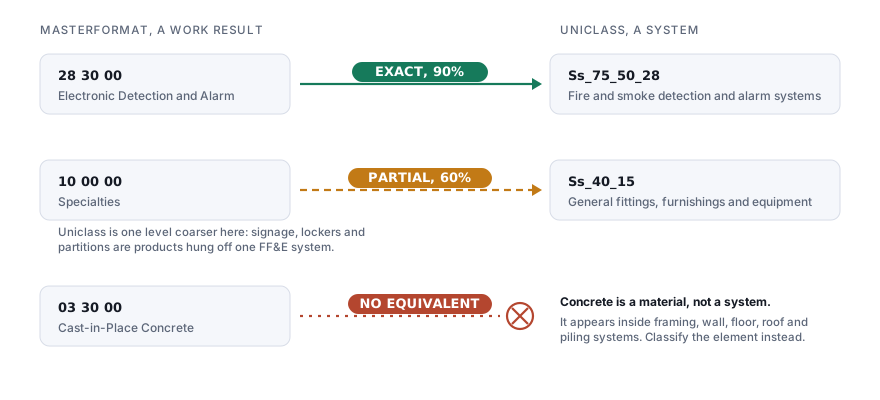
Three MasterFormat sections resolved against Uniclass: one clean match, one match at a coarser level, and one with no equivalent at all.
Where the two systems genuinely do not meet
Twelve of the 92 MasterFormat sections in the crosswalk resolve to nothing, and the pattern in them is the clearest illustration of the point this article opened with.
Division 03 Concrete has no Uniclass systems equivalent. Neither does Division 05 Metals, Division 07 Thermal and Moisture Protection, or Division 22 Plumbing. Not because Uniclass is missing something, but because these MasterFormat divisions name a material or a trade, and Uniclass Ss names a functional system. Concrete appears inside framing systems, wall systems, floor systems, roof systems and piling systems; there is no "concrete work" to point at. Plumbing splits three ways in Uniclass, into water supply, wastewater and sanitary appliances, which are unrelated systems serving different functions.
Division 13 Special Construction and Division 34 Transportation are a different kind of gap: Uniclass classifies clean rooms, pools, rail and roads through the Entity (En) table, by what the thing is, rather than as construction systems. Where a gap has no Uniclass answer at all, the report says whether an OmniClass Table 23 product code can still anchor the asset.
The useful consequence for a US team: on the services and infrastructure divisions, where both systems describe systems, the crosswalk is strong (Division 26 Electrical, 28 Electronic Safety and Security, 21 Fire Suppression and 33 Utilities all map cleanly). On the material divisions, the right move is to classify the element rather than the material, which is what the Uniclass table was built to do.
What the translator does not do
It does not store a MasterFormat or OmniClass code. Requirements and BOM items carry Uniclass Pr and Ss codes; the translator is a lookup, not a second code column. A MasterFormat section number kept in the requirement text or rationale stays searchable as text.
There is no project-level classification standard. Nothing elsewhere in ReqTwin changes based on the market a project is in, and Uniclass coding is optional: the register, traceability, ITPs, programme and cost control all work with the codes left unassigned.
The crosswalk is the Uniclass systems table only. Codes from the other Uniclass tables, including Pr products, are refused by name rather than guessed at.
The mappings are not NBS-reviewed. They were proposed against the imported Uniclass tables and reviewed row by row, which is why no confidence in the table sits above 90%. Treat a mapping as a strong starting point for a classification decision, not as a published equivalence.
UniFormat is not translated. There is no UniFormat side to the crosswalk. For elemental cost planning, the Rate Library holds org-defined rate labels, so a UniFormat Level 2 breakdown can be set up as your own rates and used in the Cost Report directly.
Frequently asked questions
Is Uniclass usable on US projects?
Technically yes, it is a public standard any team can adopt. But US lenders, owners and contractors almost universally expect OmniClass, UniFormat and MasterFormat for specifications and cost reporting, so Uniclass on a US project is generally an owner's international reporting requirement rather than the contract basis.
Is the National Master Specification (NMS) the same as MasterFormat?
NMS is the Canadian counterpart to the UK's NBS and organises its content using MasterFormat section numbers, so an NMS section ID reads as a MasterFormat code.
Can one project use two standards at once?
On a global programme, routinely: an owner reporting in Uniclass for UK and Australian assets may still deliver US contracts under MasterFormat. The usual approach is to nominate one standard as the contract basis and treat the other as a reporting view, mapped through the bSDD rather than by hand.
Which of the three should a US project start with?
UniFormat first if the immediate need is a cost plan, MasterFormat first if it is a specification index. OmniClass is the one to adopt when asset and lifecycle data has to outlive the contract, since it covers entities, spaces, elements and products in one framework.