Knowledge Base
Reading the Summary
What the Summary answers
Three things are hard to check by reading a column of numbers: where the report sits against the budget, how the direct cost splits across sections, and how the percentage build-up compounds from direct cost to the bottom line. The Summary view is those three, and nothing else. It is read-only; editing happens in the Estimate view.
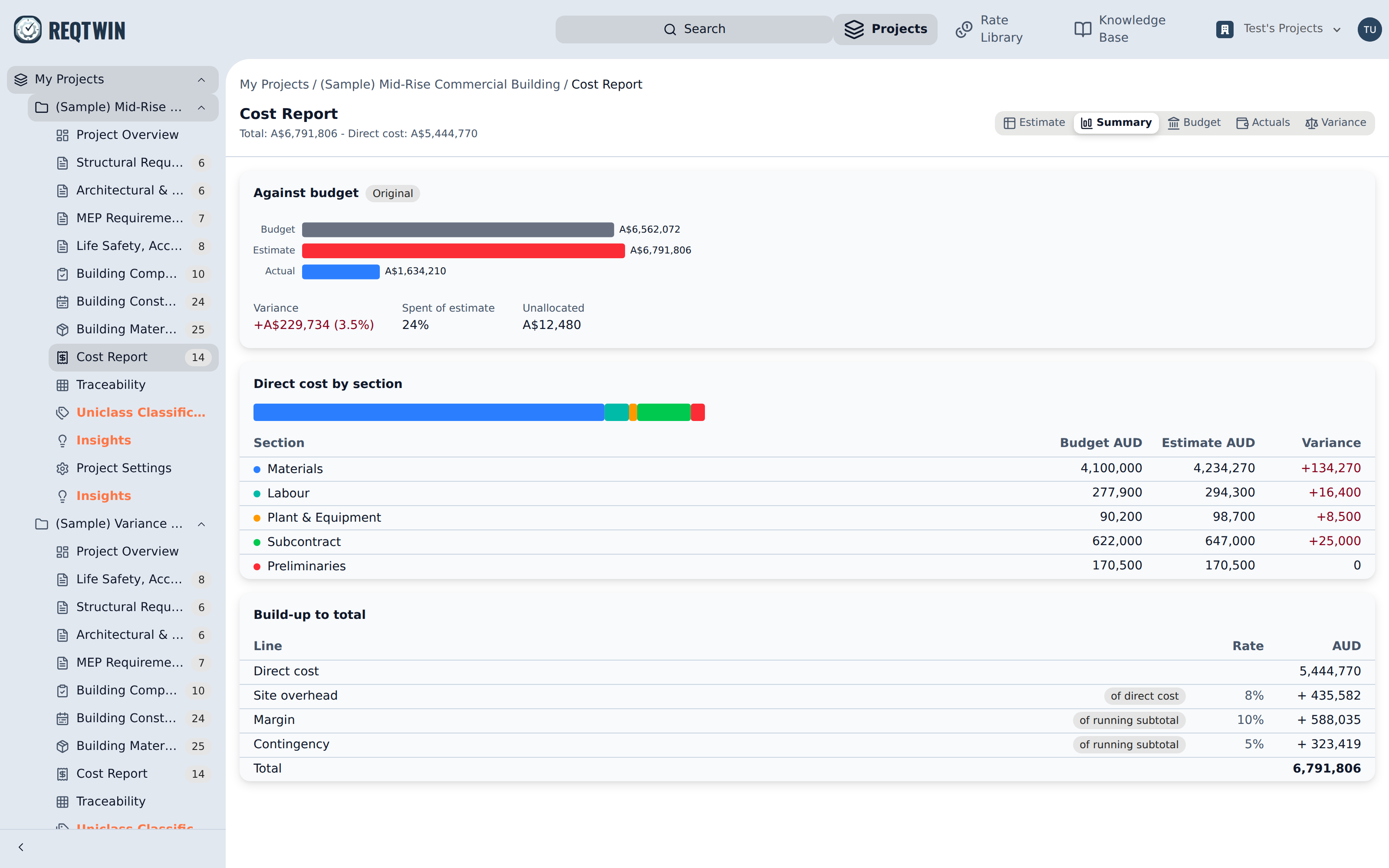
The Summary view: budget/estimate/actual bars, direct cost by section, and the build-up to total.
Against budget
The top card compares three states of the same document: the Budget in use (named beside the heading), the live Estimate, and the Actual recorded so far. Under them sit the variance (estimate minus budget, with its percentage), the share of the estimate spent to date, and the total of any entries not yet allocated to a line.
Before a budget revision is approved there is nothing to compare against, so the budget figures stay off the view entirely rather than reading as a budget of zero.
Direct cost by section
The bar and the table beneath it split direct cost across the document's top-level sections, each with its share, its budget, its estimate and the variance between them. Nested sub-sections are not listed separately: their cost is already counted in the parent's subtotal.
A section that was budgeted and has since been deleted still appears, badged Descoped, carrying its budget figure. That figure was fixed when the revision was frozen and does not disappear because the work did.
Build-up to total
The last table is the arithmetic that takes direct cost to the bottom line, one row per percentage line, each labelled with the base it runs against. Read top to bottom it shows exactly where compounding happens: a line reading "of running subtotal" applies to everything above it, including earlier percentages, which is how margin ends up applied on top of overhead.